









薬物治療学分野の研究
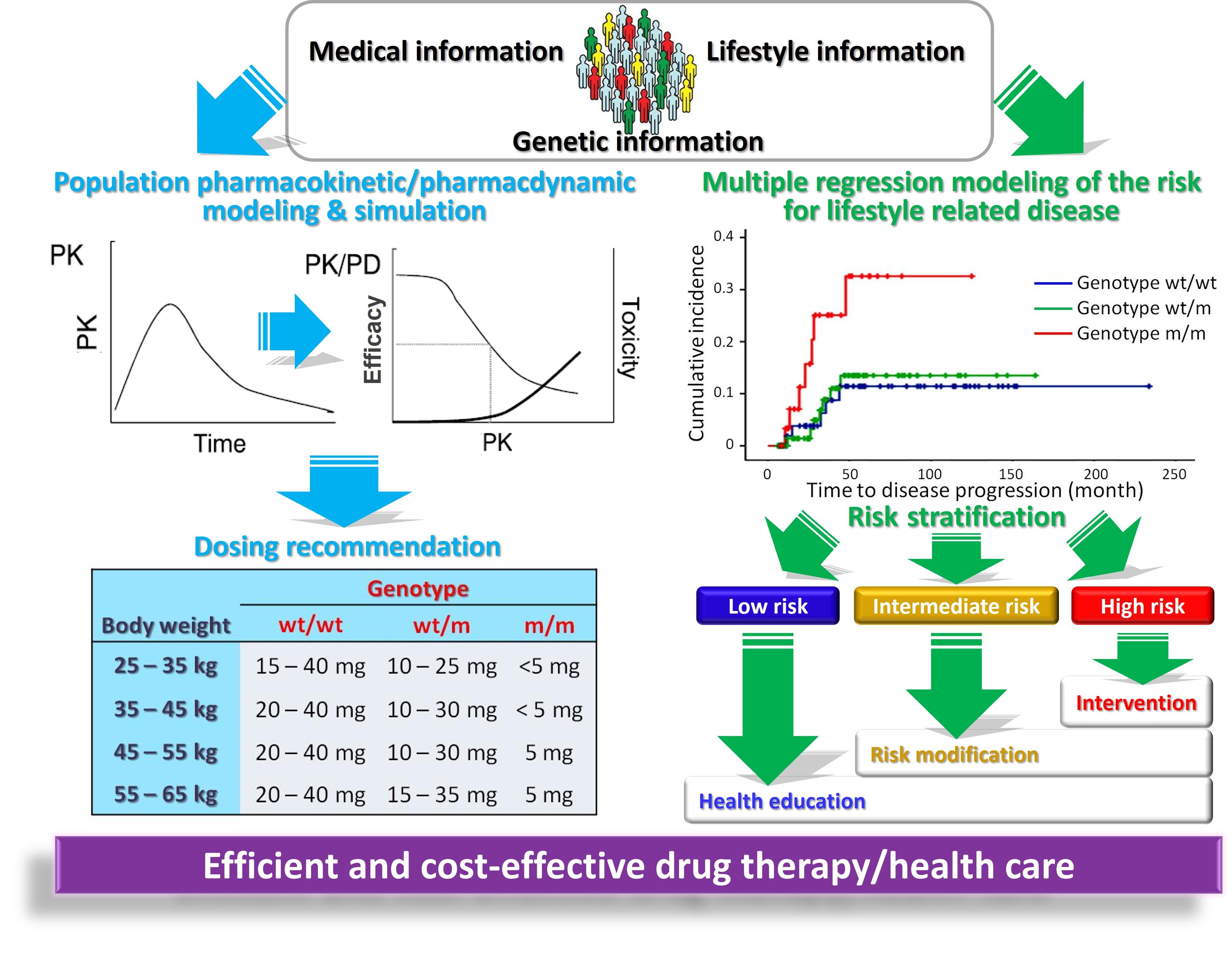
図: 薬物の個別化投与設計と副作用・生活習慣病リスクの層別化に関する当研究室の取り組み
Figure: Our approach to develop an optimized dosage at each patient and a personalized health plan based on the risk stratification
【研究概要】
当研究室では、生物統計、数理モデル、機械学習といった様々なデータサイエンスの技術を活用した臨床研究を実施しています。私共の研究は、個別化医療の推進を目的として、薬物代謝酵素等の遺伝子多型や他の個体要因(性別、喫煙歴、飲酒歴、併用薬等)と、薬物動態や薬力学、病態、疾患発症リスクとの関係を明らかにすることで、患者背景に基づく、個々に適した薬物投与量の設定と、副作用発現並びに生活習慣病のリスク層別化を行っています。
具体的には、1.モデリング&シミュレーションやAI技術を活用して、精神神経疾患治療薬の個別化投与設計法の開発を行っています。例えば、一人ひとりのうつ病患者に最適な抗うつ薬の投与設計を行うための予測モデルを作製し、高齢者では嚥下障害の改善を企図した多剤併用を是正する予測器を開発しました。また、2.生活習慣病予防のため、①疾患の発症や進展を有意に修飾する科学的根拠があり、②発症早期から 病態に関与して早期予防に役立ち、③生活習慣(喫煙など)などで介入が可能である、という3条件を満たす患者のリスク要因を重視して検討しています。これまでに 糖尿病・高血圧・脂肪肝・認知症等の発症リスクを層別化するための複数の候補遺伝子や生体内代謝物を見出し、生活習慣病の発症と進展予防のための生活改善に役立つ予測ツールの作製を目標に研究を進めています。ほかにも、3.薬の副作用発現の性差については様々な報告があるものの、その詳細は不明であることから、我々は、糖尿病の治療薬などの様々な薬物使用中に起きた副作用における性差の検討を行っています。また、4.生薬・漢方薬に関する安全性試験も行っています。
対象疾患・病態:糖尿病、脂肪肝、冠動脈疾患、心不全、うつ病、双極症、統合失調症、てんかん、認知症、各種がん、サルコペニア、他
解析ソフトウェア:Python、SPSS、R、NONMEM、PK-sim、他
[Research Overview]
Our laboratory conducts clinical research using data science techniques, including biostatistics, mathematical modeling, and machine learning. Our research aims to advance personalized medicine by clarifying the relationships among genetic
polymorphisms (e.g., drug-metabolizing enzymes), other individual factors (gender, smoking history, drinking history, concomitant medications, etc.), and pharmacokinetics, pharmacodynamics, disease states, and disease risk. This enables individualized drug dosing based on patient background and the stratification of risks for adverse events and lifestyle-related diseases.
Specifically, we are developing personalized dosing regimens for psychiatric drugs using modeling & simulation and AI technologies. For example, we created predictive models to design optimal antidepressant dosing for individual patients with depression. We developed predictors to identify polypharmacy regimens in elderly patients and to improve swallowing difficulties-furthermore, 2. For lifestyle-related disease prevention, we prioritize examining patient risk factors that meet three conditions: 1) having scientific evidence of significantly modifying disease onset or progression, 2) being involved in the disease state from early onset to aid in early prevention, and 3) being amenable to intervention through lifestyle changes (such as smoking cessation). To date, we have identified multiple candidate genes and biomarkers to stratify risk of developing diabetes, hypertension, fatty liver disease, dementia, and other conditions. Our research aims to develop predictive tools that can guide lifestyle modifications to prevent the onset and progression of lifestyle-related diseases-additionally, 3. Although various reports exist on gender differences in drug side effects, the details remain unclear. Therefore, we are examining gender differences in side effects occurring with multiple medications, including diabetes treatments. We are also conducting safety tests on herbal medicines and Kampo (traditional Japanese herbal medicine).
Target Diseases/Conditions: Diabetes, Fatty Liver Disease, Coronary Artery Disease, Heart Failure, Depression, Bipolar Disorder, Schizophrenia, Epilepsy, Dementia, Various Cancers, Sarcopenia, etc.
Programming Language or Analytical Software: Python, SPSS, R, NONMEM, PK-sim, etc.